

In software engineering, a class diagram in the Unified Modeling Language (UML) is a type of static structure diagram that describes the structure of a system by showing the system's classes, their attributes, operations (or methods), and the relationships among objects.
Are you looking for a Free UML tool for learning UML faster, easier and quicker? Visual Paradigm Community Edition is a UML software that supports all UML diagram types. It is an international award-winning UML modeler, and yet it is easy-to-use, intuitive & completely free.
Free DownloadA UML class diagram is made up of:
A description of a group of objects all with similar roles in the system, which consists of:
A class notation consists of three parts:

The graphical representation of the class - MyClass as shown above:
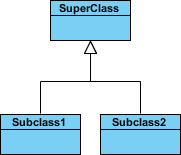
A class may be involved in one or more relationships with other classes. A relationship can be one of the following types: (Refer to the figure on the right for the graphical representation of relationships).
| Relationship Type | Graphical Representation |
|---|---|
Inheritance (or Generalization):
|
 |
Simple Association:
|
 |
Aggregation: A special type of association. It represents a "part of" relationship.
|
 |
Composition: A special type of aggregation where parts are destroyed when the whole is destroyed.
|
 |
Dependency:
|
 |

In object-oriented design, there is a notation of visibility for attributes and operations. UML identifies four types of visibility: public, protected, private, and package.
The +, -, # and ~ symbols before an attribute and operation name in a class denote the visibility of the attribute and operation.
In the example above:
Access for each of these visibility types is shown below for members of different classes.
| Access Right | public (+) | private (-) | protected (#) | Package (~) |
|---|---|---|---|---|
| Members of the same class | yes | yes | yes | yes |
| Members of derived classes | yes | no | yes | yes |
| Members of any other class | yes | no | no | in same package |
How many objects of each class take part in the relationships and multiplicity can be expressed as:


A class diagram may also have notes attached to classes or relationships. Notes are shown in grey.

In the example above:
We can interpret the meaning of the above class diagram by reading through the points as following.
Building a robust static structure doesn't have to start from a blank canvas. Whether you are using our Desktop modeler for precision editing or our AI Ecosystem for rapid generation, Visual Paradigm automates the path from requirements to Class Diagrams.
⚡ AI Class Diagram Wizard: Step-by-step assistant for classes, attributes, and operations.
🔄 Use Case Studio: Automatically extracts domain classes from behavior descriptions.
🚀 Agilien: Bridge User Stories/Epics directly to structural UML models.
💾 DB Modeler AI: Generates conceptual Domain Class Diagrams for database design.
🏛️ MVC Architecture: Generates specialized Controller Class Diagrams.
Inevitably, if you are modeling a large system or a large business area, there will be numerous entities you must consider. Should we use multiple or a single class diagram for modeling the problem? The answer is:
We can use class diagrams in different development phases of a software development lifecycle and typically by modeling class diagrams in three different perspectives (levels of detail) progressively as we move forward:
Conceptual perspective: The diagrams are interpreted as describing things in the real world. Thus, if you take the conceptual perspective you draw a diagram that represents the concepts in the domain under study. These concepts will naturally relate to the classes that implement them. The conceptual perspective is considered language-independent.
Specification perspective: The diagrams are interpreted as describing software abstractions or components with specifications and interfaces but with no commitment to a particular implementation. Thus, if you take the specification perspective we are looking at the interfaces of the software, not the implementation.
Implementation perspective: The diagrams are interpreted as describing software implementations in a particular technology and language. Thus, if you take the implementation perspective we are looking at the software implementation.
You've learned what a Class Diagram is and how to draw a Class Diagram. It's time to draw a Class Diagram of your own. Get Visual Paradigm Community Edition, a free UML software, and create your own Class Diagram with the free Class Diagram tool. It's easy-to-use and intuitive.
Free Download
