
In the complex landscape of modern business operations, clarity is currency. Whether you are a Product Manager looking to streamline user onboarding, a Business Analyst mapping out supply chain logistics, or a Developer integrating disparate systems, the ability to visualize how work gets done is critical.
Business Process Model and Notation (BPMN) 2.0 has emerged as the global standard for this visualization. However, many practitioners stop at drawing simple flowcharts, missing the deeper architectural power of the specification. BPMN 2.0 isn't just one type of diagram; it offers three distinct lenses through which to view business interactions: Orchestration, Choreography, and Conversation.
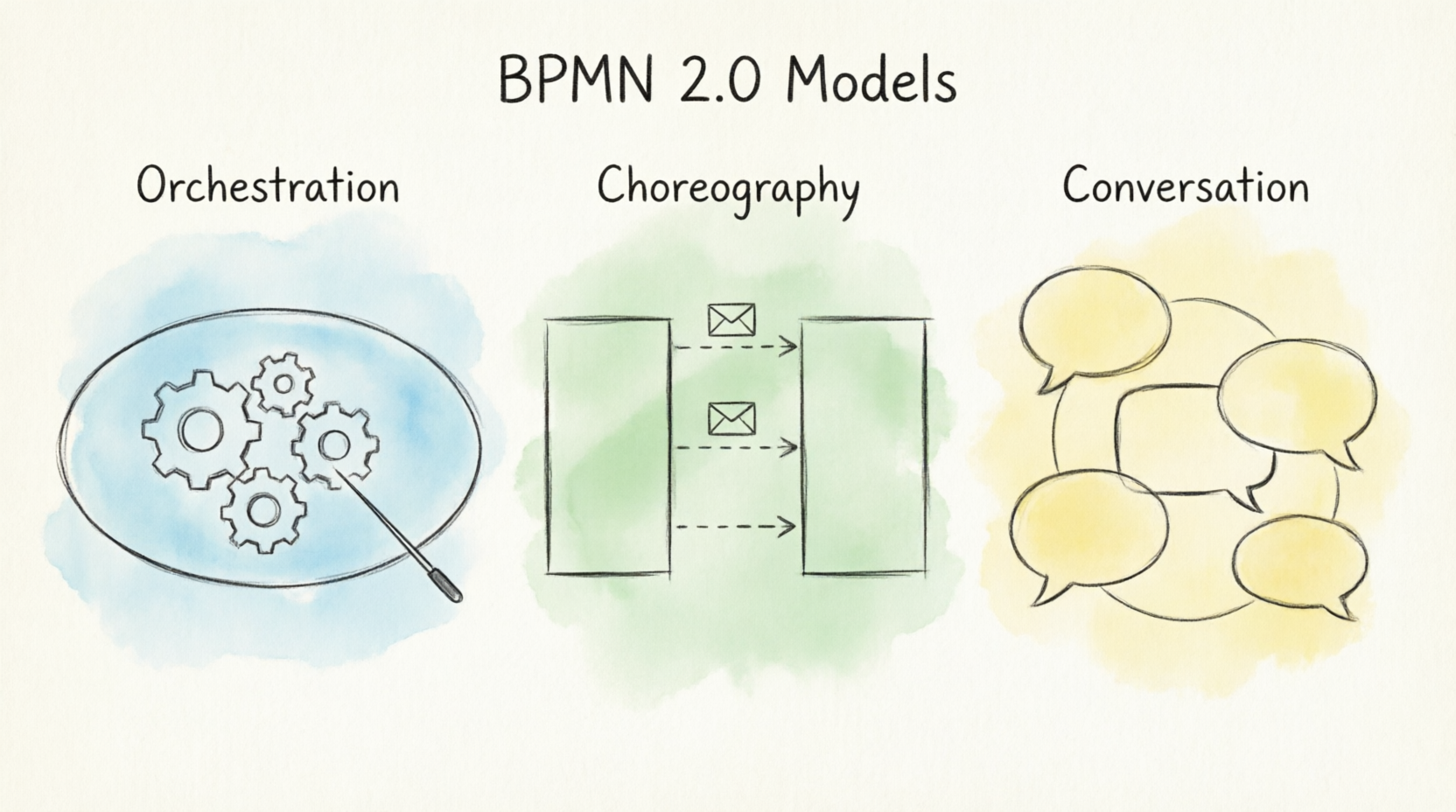
While orchestration is the most common starting point—focusing on the internal steps of a single entity—understanding when to shift your perspective to choreography (inter-party interactions) or conversation (high-level communication groups) can transform how your organization handles complexity, compliance, and digital transformation. This guide breaks down these three models, providing clear examples, best practices, and strategic guidelines on when to use each.
Orchestration is the backbone of most BPMN implementations. It describes how a single participant (represented visually as a "Pool") coordinates a set of activities to achieve a specific outcome. Think of it as the internal playbook for one organization or system.
Single Point of Control: One participant acts as the "offensive coordinator," determining when the process starts, the order of tasks, and when it ends.
Internal Flow: Uses Sequence Flows (solid lines with arrowheads) to dictate the order of activities, gateways, and events. Crucially, these flows never cross the boundary of the pool.
Visibility: It reveals the "private" work that happens behind the scenes.
| Type | Description | Use Case |
|---|---|---|
| Private Non-Executable | High-level internal actions lacking technical details for system execution. | Documenting human-centric workflows, training materials, or initial brainstorming sessions. |
| Private Executable | Contains all semantic details required to be run by a business process engine (BPEL). | Automated backend processes, such as data validation pipelines or automated approval routing. |
| Public Processes | Depicts only the activities used to communicate with external parties, hiding internal complexity. | Defining the "interface" of your process for partners without revealing proprietary internal logic. |
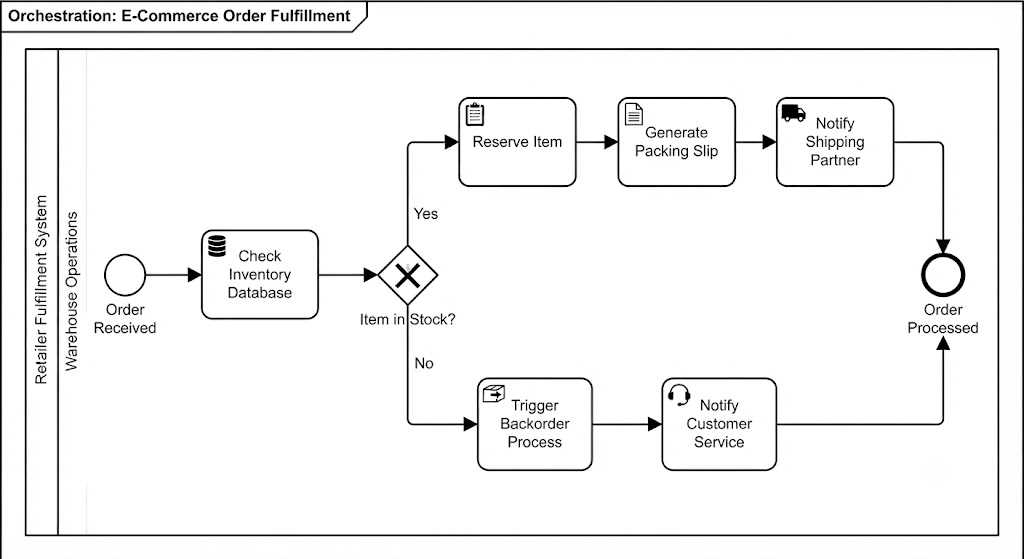
Imagine an online retailer processing an order. An Orchestration model would map the internal steps within the retailer’s warehouse system:
Receive Order Event.
Check Inventory Database (Task).
Gateway: Is item in stock?
Yes: Reserve Item -> Generate Packing Slip -> Notify Shipping Partner.
No: Trigger Backorder Process -> Notify Customer Service.
End Event: Order Processed.
Note: The customer and the shipping partner are external entities. The orchestration model focuses solely on what the retailer does internally.
If orchestration is about what happens inside one house, choreography is about the dance between two houses. Choreography models focus on the interaction between participants rather than their internal work.
Shared Responsibility: No single participant controls the entire flow. Instead, the model defines a standardized set of rules for message exchange.
The "Contract": It acts as a binding agreement on how different organizations or systems should interact, without revealing their private internal orchestrations.
Message-Centric: The primary elements are messages exchanged between participants, often visualized using "Choreography Tasks" where the initiating and receiving participants are clearly linked.
Consider a customer filing a claim with an insurance company, which then needs verification from a third-party repair shop.
Orchestration View: The insurance company’s internal model shows how they route the claim to an adjuster. The repair shop’s internal model shows how they schedule the inspection.
Choreography View: This model ignores those internal steps. It only shows:
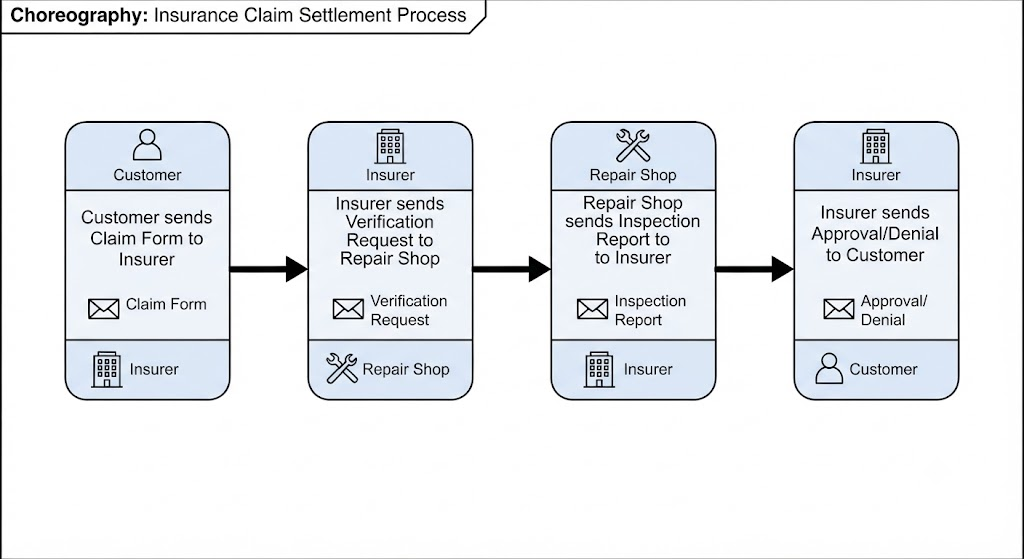
Customer sends Claim Form to Insurer.
Insurer sends Verification Request to Repair Shop.
Repair Shop sends Inspection Report to Insurer.
Insurer sends Approval/Denial to Customer.
This ensures that both the Insurer and the Repair Shop agree on the sequence of messages, even if their internal IT systems are completely different.
When dealing with large ecosystems involving dozens of partners, detailed choreographies can become overwhelming. Conversation models provide a logical grouping of message exchanges.
Abstraction: It strips away the sequence and timing of individual messages.
Topic-Based: Focuses on the "topic" of communication (the conversation) rather than the mechanics.
Stakeholder Friendly: Ideal for executives or stakeholders who need to understand who is talking to whom and about what, without getting bogged down in technical details.
A multinational manufacturer interacts with raw material suppliers, logistics providers, customs agencies, and retailers.
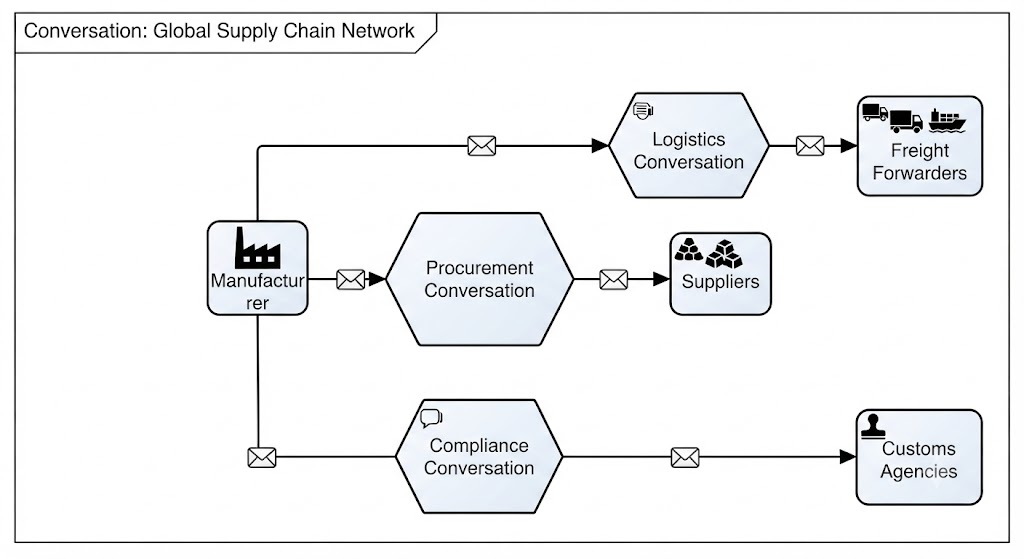
A Conversation Model would simply show bubbles (Conversation Nodes) connecting these entities:
"Procurement Conversation" between Manufacturer and Suppliers.
"Logistics Conversation" between Manufacturer and Freight Forwarders.
"Compliance Conversation" between Manufacturer and Customs Agencies.
It answers the question: "Do we have a defined communication channel with our customs broker?" without detailing every document exchanged.
| Feature | Orchestration | Choreography | Conversation |
|---|---|---|---|
| Primary Focus | Internal work of a single participant. | Interaction between two or more participants. | Grouping of communications between participants. |
| Control Structure | Centralized control by one "Coordinator" (Pool). | Shared responsibility; peer-to-peer interaction. | High-level overview of relationships. |
| Key Visual Element | Sequence Flows within a Pool. | Choreography Tasks & Message Links. | Conversation Nodes & Links. |
| Level of Detail | High (Step-by-step activities). | Medium (Message exchange sequence). | Low (Logical grouping of topics). |
| Best For | Process automation, internal efficiency, bottleneck identification. | B2B integration, API contracts, multi-party agreements. | Strategic planning, ecosystem mapping, stakeholder alignment. |
Start Private, Go Public Later: Begin by mapping your internal non-executable processes to capture employee knowledge. Only define public processes once internal stability is achieved.
Keep Pools Pure: Never let sequence flows cross pool boundaries. If a flow needs to go to another participant, use a Message Flow (dashed line) to trigger an event in the other pool.
Define Executability Early: Decide if a process is meant for human understanding (Non-Executable) or system automation (Executable). Executable models require strict adherence to data types and error handling.
Hide Internal Complexity: Use choreography to protect proprietary information. Partners only need to know when to send a message, not how you generate the response.
Validate Message Contracts: Ensure that every message sent in the choreography has a corresponding receive event in the participant’s orchestration model.
Avoid Over-Engineering: Don’t try to model every possible exception in a choreography. Keep it focused on the "happy path" and standard error messages.
Use as a Entry Point: Start with a conversation model to identify all stakeholders in a complex ecosystem before diving into detailed choreographies.
Group by Business Capability: Name conversations based on business functions (e.g., "Billing," "Onboarding," "Support") rather than technical protocols.
Link to Detailed Models: Use conversation nodes as hyperlinks or references to the underlying choreography or orchestration diagrams for those who need deeper detail.
Choosing the right model depends on your audience and your goal.
You are optimizing internal operational efficiency.
You are building a workflow for a business process engine (automation).
You need to train employees on internal procedures.
You are identifying bottlenecks within a single department or system.
You are integrating with external partners, vendors, or customers.
You need to define an API or service-level agreement (SLA) regarding message exchange.
Multiple independent entities must coordinate actions without a central controller.
You want to standardize interactions across different branches or subsidiaries.
You are presenting to executive leadership or non-technical stakeholders.
You are mapping a large, complex ecosystem with many participants.
You need to audit communication channels for compliance or security.
You are in the early discovery phase of a project and need to identify key players.
Mastering BPMN 2.0 requires more than just knowing how to draw a rectangle or a diamond. It demands a strategic understanding of perspective.
Orchestration gives you control over your internal world, turning chaotic tasks into streamlined, executable workflows. Choreography builds bridges to the outside world, ensuring seamless, standardized interactions with partners. Conversation provides the bird’s-eye view, helping you navigate the complexity of large-scale business ecosystems.
For organizations embarking on digital transformation, the journey typically begins with orchestration. By capturing internal knowledge and establishing baseline processes, companies create the stability needed to then engage in complex choreographies with external systems. Throughout this journey, conversation models serve as the essential map, ensuring that no stakeholder is left out of the loop.
By selecting the right model for the right problem, you move beyond simple diagramming to true business architecture—creating clarity, driving efficiency, and enabling innovation.

