
In modern software development, one of the most persistent challenges is the communication gap between business stakeholders and engineering teams. Business leaders often think in terms of processes, outcomes, and user experiences, communicating through flowcharts, meetings, and high-level requirements. Engineers, on the other hand, operate in the realm of code, algorithms, and system architecture. This disconnect frequently leads to misaligned expectations, costly rework, and products that fail to deliver true business value.
Business Process Model and Notation (BPMN) emerges as a powerful solution to this challenge. More than just a diagramming standard, BPMN serves as a universal graphical language that translates abstract business requirements into concrete technical designs. By providing a shared visual framework, BPMN enables both business and technical teams to speak the same language, ensuring that the human purpose behind software is clearly understood by those building it. This guide explores how BPMN functions as a critical bridge between these two worlds, facilitating clearer communication, better decision-making, and more successful product delivery.
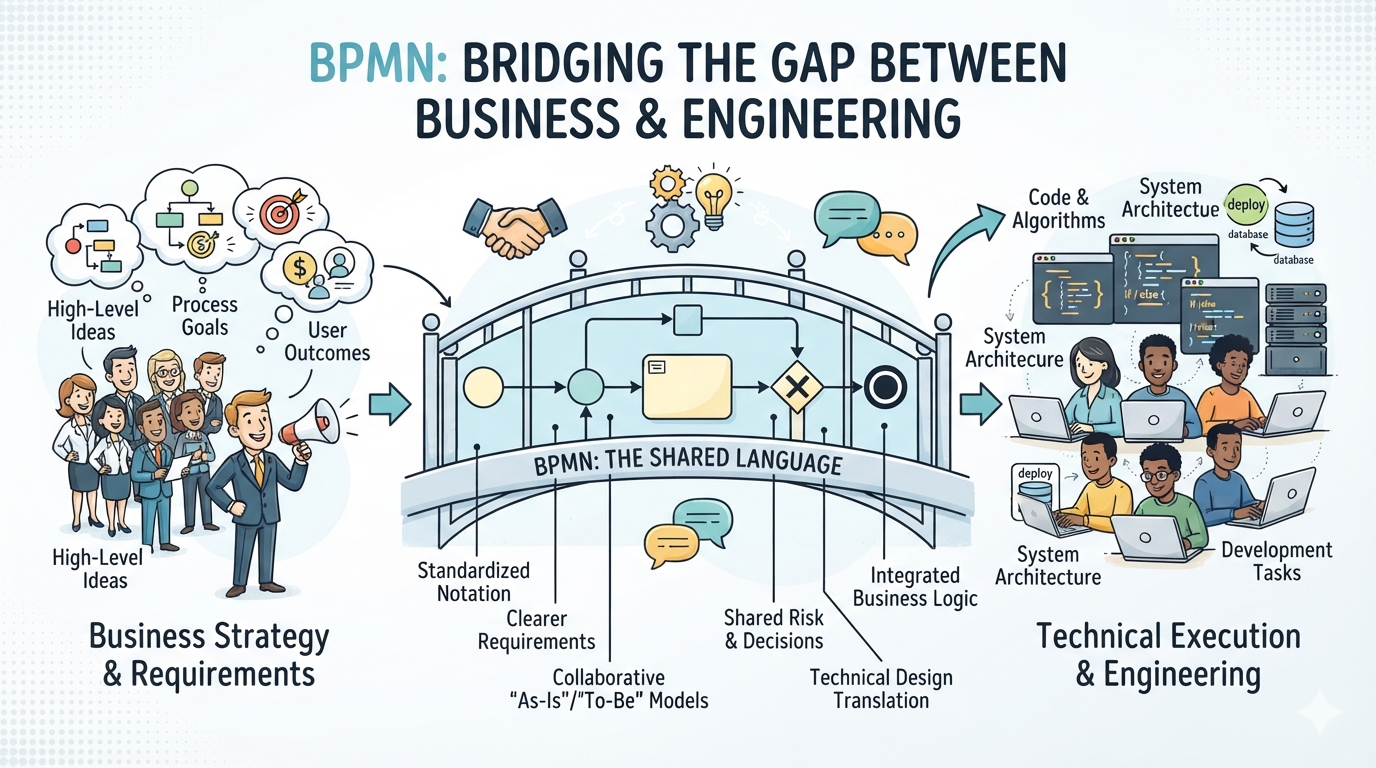
One of BPMN’s primary strengths is its ability to convert complex stakeholder ideas into structured technical designs. When business teams articulate their needs through BPMN diagrams, software engineers gain a clear reference point for writing system code. This translation process ensures that the final product aligns closely with business expectations and priorities, reducing ambiguity and minimizing the risk of building features that don’t serve their intended purpose.
BPMN offers standardized notations that carry specific, agreed-upon meanings across diverse audiences. Whether you’re a subject matter expert, developer, project leader, or executive, BPMN diagrams provide a common visual language that everyone can interpret consistently. This standardization eliminates the need for engineers to reverse-engineer code to understand architectural decisions. Instead, teams can review diagrams to quickly grasp process flows, decision points, and system interactions, saving time and reducing errors.
BPMN supports a two-way flow of information between business and technical teams. On one hand, engineering leads can use BPMN to communicate design intent from architects to the development team, ensuring everyone understands the technical roadmap. On the other hand, engineers can leverage BPMN to relay technical suggestions and constraints back to architecture and design groups. This bilateral communication fosters collaboration, allowing both sides to contribute their expertise and reach mutually beneficial solutions.
Effective software development requires thoughtful risk management and clear decision-making frameworks. BPMN enables teams to document risk-related decisions, such as determining when to deploy code despite minor errors or identifying which issues require escalation. By modeling these processes visually, development teams can work collaboratively with stakeholders to clarify decision ownership. This transparency ensures that risks are managed appropriately and that functional owners are engaged when necessary.
BPMN facilitates the creation of both “as-is” models (representing current processes) and “to-be” models (illustrating future automated states). This comparative approach allows stakeholders and engineers to collaborate on identifying new system requirements. By visualizing how automation will eliminate manual actions and reduce processing time, teams can prioritize improvements, allocate resources effectively, and set realistic expectations for project outcomes.
Advanced BPMN modeling goes beyond simple process flows by integrating business rules and technical tasks. Through connections with DMN (Decision Model and Notation), BPMN can incorporate explicit business rules and decision criteria. Additionally, BPMN supports service tasks and script tasks, which represent technical operations within the process. This integration allows engineers to build the “scaffolding” for code based on success and failure criteria defined directly in the business model, ensuring that technical implementation aligns seamlessly with business logic.
BPMN is far more than a diagramming tool—it is a strategic asset that bridges the gap between business vision and technical execution. By providing a common graphical language, BPMN enables stakeholders and engineers to collaborate effectively, translate requirements into actionable designs, and make informed decisions throughout the development lifecycle. The result is software that not only meets technical specifications but also delivers genuine business value.
For organizations seeking to reduce rework, improve communication, and align delivery with business strategy, adopting BPMN as a standard practice is a transformative step. By embracing this shared visual framework, teams can ensure that the human purpose behind every line of code is clearly understood, leading to products that truly serve their intended users and achieve their strategic goals.

