In modern organizations, a persistent challenge exists between business stakeholders who define what needs to be achieved and engineering teams who determine how to build it. Misunderstandings in this handoff often lead to scope creep, delayed releases, and solutions that fail to meet core business needs.
Business Process Model and Notation (BPMN) 2.0 offers a powerful solution to this friction. More than just a diagramming standard, BPMN serves as a common graphical language that translates high-level business requirements into precise, technical implementation plans. By providing a standardized visual syntax, BPMN allows business analysts, architects, and engineers to collaborate on a single source of truth. This guide explores the core concepts of BPMN, demonstrates its application in real-world scenarios, and provides best practices for creating models that are both readable and actionable.
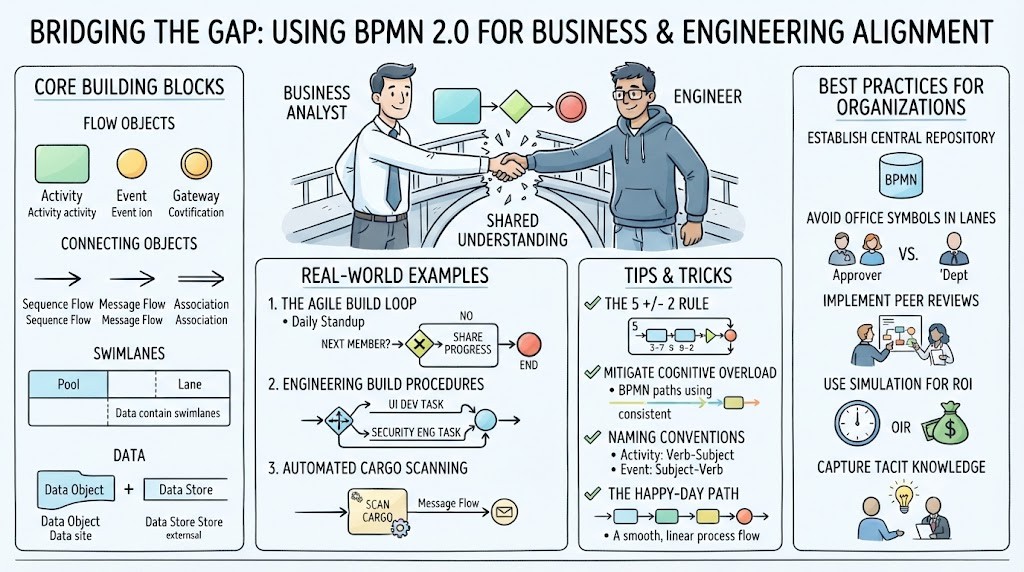
1. The Core Building Blocks (Key Concepts)
BPMN is organized into five basic categories that provide easily recognizable elements for any reader, regardless of their technical background. Mastering these primitives is the first step toward effective process modeling.
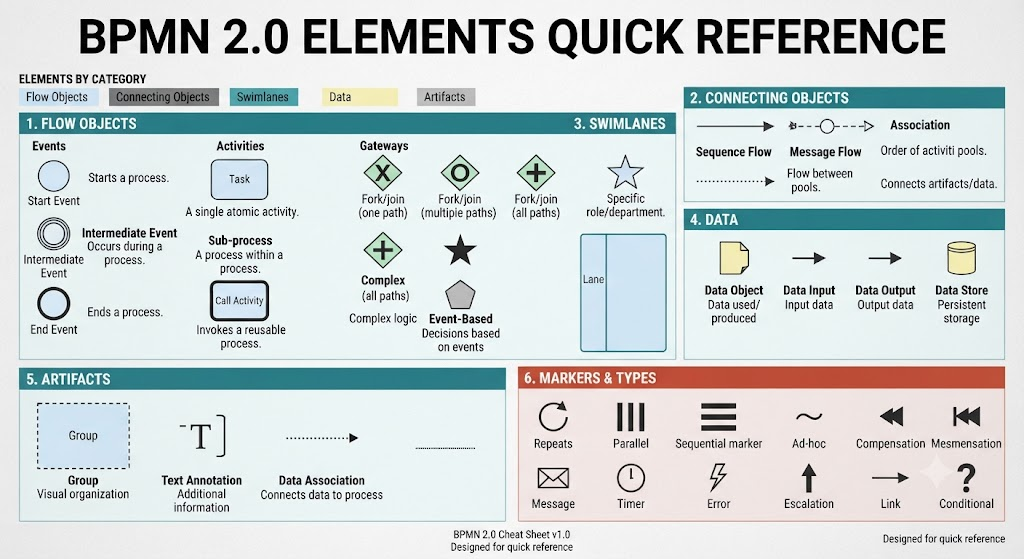
Flow Objects
These are the primary elements that define the behavior of a process.
- Activities: Represent work or operations performed within the process (e.g., "Review Estimate," "Validate Input").
- Events: Something that "happens" during the course of a process, affecting the timing or sequence. Events are categorized as Start, Intermediate, or End events.
- Gateways: Decision points used for divergence (forking paths based on conditions) and convergence (merging paths back together).
Connecting Objects
These elements link flow objects together to define the logic and flow of information.
- Sequence Flows: Solid lines with arrowheads that show the specific order in which activities are performed.
- Message Flows: Dashed lines with open arrowheads that show information passing between different participants or pools (often across organizational boundaries).
- Associations: Dotted lines that connect data, artifacts, or annotations to flow objects without affecting the sequence flow.
Swimlanes
Swimlanes organize responsibilities and clarify who is doing what.
- Pools: Represent a major participant in the process or an entire process container. Interactions between pools typically occur via message flows.
- Lanes: Sub-partitions within a pool that represent specific roles, departments, or systems (e.g., "Supervisor," "Developer," "Payment Gateway").
Data
Notations for information created, consumed, or stored during the process.
- Data Objects: Represent information needed for or produced by activities (e.g., "Invoice," "User Profile").
- Data Stores: Represent persistent storage where data resides beyond the immediate process execution (e.g., databases, file servers).
2. Real-World Bridging Examples
BPMN shines when applied to complex interactions between business logic and technical execution. Here are three examples of how it bridges the gap.
The Agile Build Loop
In an Agile environment, communication rituals like the daily standup are critical. The "standup loop" is a prime example of bridging business expectations with engineering reality.
- Modeling Approach: Use an exclusive gateway to model the decision point: "Are there remaining team members to speak?"
- Benefit: Sequence flows show the repetition of members sharing progress until no one is left. This ensures the ritual’s structure is understood by both non-technical stakeholders and the technical team, clarifying time-boxing and participation rules.
Engineering Build Procedures
Lead engineers can use BPMN to document build problem procedures, transforming tribal knowledge into standardized processes.
- Modeling Approach: When a build issue is identified, a parallel gateway can illustrate specialized tasks occurring simultaneously. For example, UI developers and security engineers can work in tandem to resolve a blocker.
- Benefit: This creates a "living document" that eliminates the need for stakeholders to understand the underlying code while ensuring all technical dependencies are visually mapped.
Automated Cargo Scanning
In logistics and operations, automation is key to efficiency. BPMN makes invisible automated processes visible to business leaders.
- Modeling Approach: Use a service task (marked with a gear icon) to represent an automated activity triggered by a web service, such as "Scan Cargo."
- Benefit: Modeling the atomic-level steps of an engineered solution reveals exactly how automation reduces manual bottlenecks, helping business leaders justify investment in technical infrastructure.
3. Tips and Tricks for Effective Modeling
Creating clear, usable models requires attention to detail and cognitive psychology.
- The 5 +/- 2 Rule: When using expanded subprocesses, keep them between three and seven activities.
- Why? Any more makes the model too complex to display effectively; any fewer may not warrant an expanded view. This aligns with human working memory limits.
- Mitigate Cognitive Overload: Stakeholders often "tune out" when faced with dense diagrams. Use matching colors for related gateways and sequence flows to create a "pop-out" effect, guiding the eye through logical paths.
- Naming Conventions: Consistency in naming reduces ambiguity.
- Activities: Use Verb-Subject construction (e.g., "Complete Paperwork," "Deploy Code").
- Events: Use Subject-Verb construction (e.g., "Message Received," "Timer Expired").
- The "Happy-Day Path": Always model the standard, error-free process first.
- Why? This keeps clients engaged and prevents the model from becoming overwhelming too early. Add exception paths and error handling only after the main flow is agreed upon.
4. Best Practices for Organizations
To maximize the value of BPMN, organizations should adopt strategic practices that promote consistency and reuse.
- Establish a Central Repository: Treat BPMN elements as primitives. Define an activity or participant once and store it for reuse. This accelerates modeling and ensures consistency across the enterprise, similar to how the auto industry reuses part designs across multiple vehicle models.
- Avoid Office Symbols in Lanes: Office symbols and department names change frequently due to reorgs. Instead, use roles (e.g., "Clerk," "Manager," "Approver"), which are more stable and keep your models from going out of date quickly.
- Implement Peer Reviews: Much like scientific journals, a formal peer-review process for BPMN models ensures high quality and facilitates the transfer of knowledge between junior and senior practitioners.
- Use Simulation for ROI: Populate your models with process details such as time, cost, and resource metrics. This allows you to run "what-if" simulations to support procurement decisions and prove the financial impact of a proposed "to-be" state before writing a single line of code.
- Capture Tacit Knowledge: The "secret sauce" of a competitive advantage is often the informal expertise held by employees. Use interview sessions to surface these mental models and transform them into explicit knowledge in your BPMN diagrams, preserving institutional wisdom.
Conclusion
BPMN 2.0 is more than a diagramming tool; it is a strategic asset for alignment. By providing a shared visual language, it empowers business analysts to articulate requirements clearly, enables architects to design robust solutions, and allows engineers to implement processes with precision.
When organizations adopt the core building blocks, apply real-world bridging techniques, and adhere to best practices like role-based swimlanes and peer reviews, they reduce ambiguity and accelerate delivery. Ultimately, the goal is not just to draw processes, but to create living documents that drive continuous improvement, capture tacit knowledge, and deliver measurable ROI. Start with the happy path, keep it simple, and let BPMN bridge the gap between vision and execution.