In the complex landscape of software development, one of the most persistent challenges is the "translation gap" between business stakeholders and engineering teams. Business leaders articulate needs in terms of outcomes, efficiency, and customer value, while engineers think in terms of logic, data structures, and code. Misalignment at this intersection often leads to scope creep, missed requirements, and systems that technically function but fail to deliver business value.
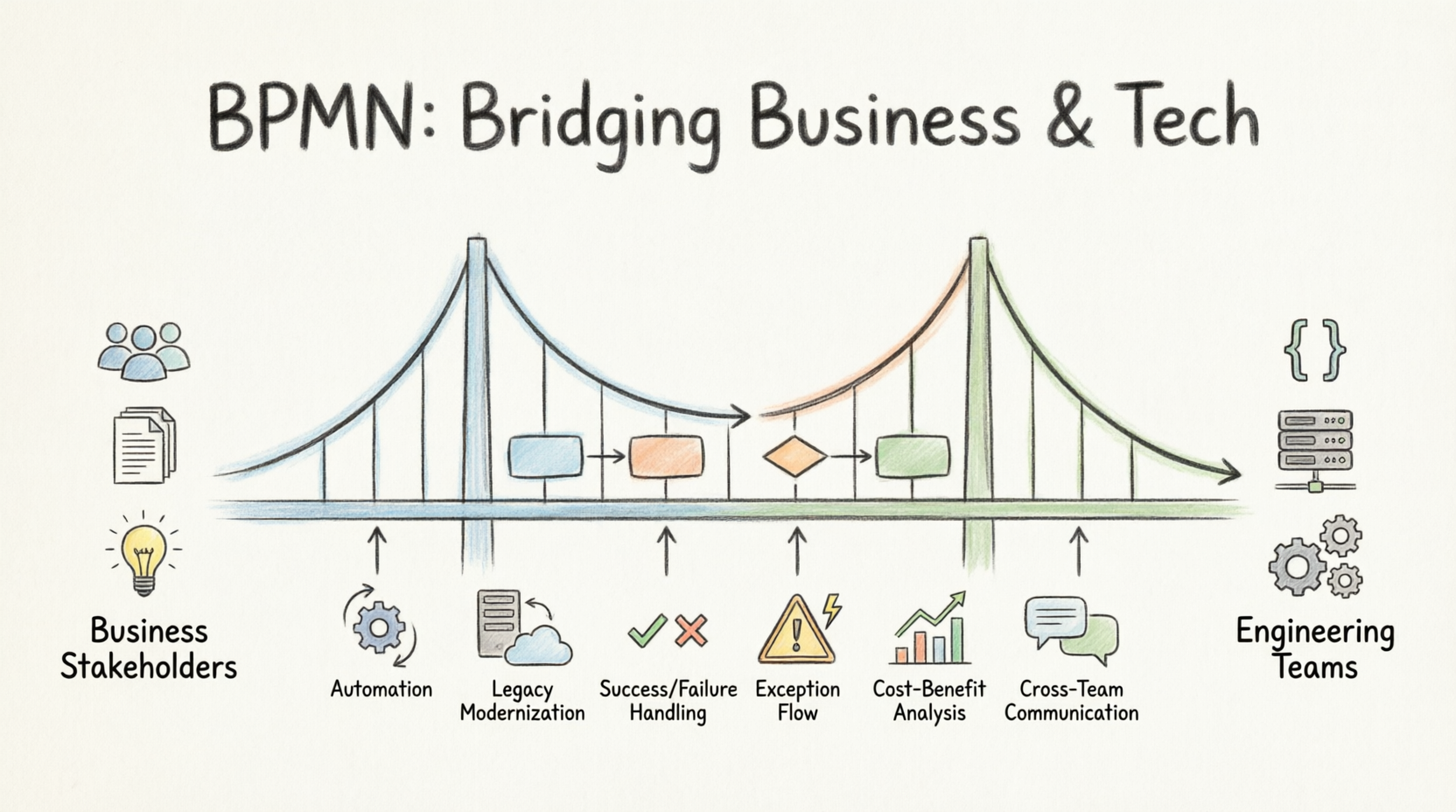
Business Process Model and Notation (BPMN) has emerged as a critical bridge in this divide. Far more than just a diagramming tool, BPMN provides a standardized visual language that translates high-level business concepts into actionable technical designs. By capturing both process flows and technical details, BPMN ensures that the software being built aligns precisely with business needs and priorities. This guide explores how BPMN serves as a vital instrument for defining system requirements, modernizing legacy systems, and driving data-driven decision-making.
1. Shaping "To-Be" States: From Legacy Baselines to Future Automation
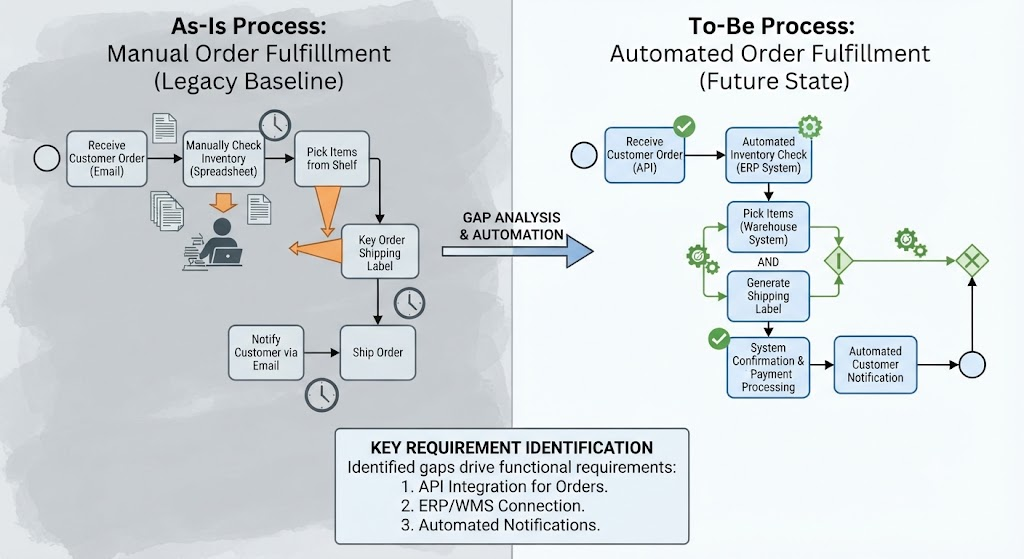
One of the primary ways BPMN defines system requirements is by contrasting current realities with future aspirations.
- Documenting the "As-Is": Organizations begin by mapping their current legacy processes. This baseline captures every manual action, handoff, and bottleneck, providing a clear picture of where inefficiencies lie.
- Designing the "To-Be": Using the "as-is" model as a foundation, teams create a "to-be" model that illustrates the desired future state. This model explicitly identifies new system requirements by showing how automation will eliminate manual tasks, reduce processing time, and streamline workflows.
- Requirement Identification: The gap between the "as-is" and "to-be" models directly translates into a list of functional requirements. If a manual approval step is removed in the "to-be" model, the system must be designed to handle automated validation or rule-based decision-making.
2. Modernizing Legacy Systems: Capturing Hidden Logic
Legacy systems often contain critical business logic that is poorly documented or known only by long-tenured employees. BPMN plays a crucial role in uncovering and preserving this knowledge during modernization efforts.
- Step-by-Step Capture: BPMN allows architects and engineers to map out the specific steps users complete in aging systems. This detailed capture ensures that no critical functionality is overlooked during the transition to new technology.
- Competitive Advantage: By accurately shaping the requirements necessary to modernize these processes, organizations can not only replicate existing functionality but also enhance it. This leads to systems that are more robust, scalable, and aligned with current competitive standards.
3. Defining Success and Failure Criteria with Service Tasks
Advanced BPMN elements, particularly service tasks, provide engineers with precise instructions on how system components should behave.
- Explicit Criteria: Service tasks allow engineers to identify specific success and failure criteria for each process step. For example, a service task might represent an API call to a payment gateway, with clear definitions of what constitutes a successful transaction versus a failed one.
- Code Scaffolding: These criteria serve as the "scaffolding" for system code. Developers can build error handling, retry logic, and status updates directly from the BPMN model, ensuring that the system supports all required business logic without ambiguity.
4. Modeling Exception Flows: Preparing for the Unexpected
A robust system must handle not only happy paths but also errors and unexpected conditions. BPMN uses boundary events to explicitly define these scenarios.
- Error Handling: Boundary events attached to tasks or subprocesses specify how the system should react when things go wrong. This could include timeouts, data validation errors, or external system failures.
- Preventing Overdevelopment: By clearly defining exception flows, BPMN helps engineering teams avoid overdeveloping functionality. Instead of guessing how to handle every possible error, developers follow the roadmap provided by the model, ensuring consistent and predictable system behavior during exceptions.
5. Decision Support and Cost-Benefit Analysis: Data-Driven Procurement
BPMN models are not just static diagrams; they can be populated with rich data to support strategic decisions.
- Process Details: By adding information such as who is involved in each step, what data is used, and how much time each activity takes, organizations can create detailed simulations of their processes.
- Financial Impact Assessment: These simulations allow teams to assess the expected financial impact of new technology before implementation. For example, if a BPMN model shows that automating a specific task will save 10 hours per week per employee, the cost-benefit analysis becomes concrete and defensible. This data-driven approach supports smarter procurement decisions and prioritizes investments with the highest ROI.
6. Bridging Communication Gaps: A Universal Language
Perhaps the most significant benefit of BPMN is its ability to serve as a common language for diverse stakeholders.
- Standardized Format: Stakeholders often communicate via diagrams, while engineers communicate via code. BPMN provides a standard, consumable format that both groups can understand.
- Preventing Loss in Translation: By using BPMN, requirements are less likely to be "lost in translation" between business and technical teams. Engineering leads can relay design intent clearly to development teams, ensuring that everyone is working from the same playbook. This alignment reduces rework, accelerates development cycles, and improves overall project success rates.
Conclusion
BPMN is more than a modeling notation; it is a strategic tool for aligning business vision with technical execution. By shaping "to-be" states, modernizing legacy systems, defining precise success criteria, modeling exception flows, supporting data-driven decisions, and bridging communication gaps, BPMN ensures that system requirements are clear, comprehensive, and aligned with business goals.
For organizations looking to build software that truly delivers value, adopting BPMN as a core part of the requirements definition process is not just beneficial—it is essential. It transforms abstract business ideas into concrete technical designs, reducing risk, enhancing clarity, and ultimately leading to systems that work better for both users and the business.<