In the world of business process management, clarity is currency. However, as organizations attempt to model real-world operations, process diagrams often become tangled webs of gateways and conditional flows. When complex decision logic—such as pricing calculations, regulatory compliance checks, or risk assessments—is embedded directly into a Business Process Model and Notation (BPMN) diagram, the result is frequently an unreadable "spaghetti" chart that is difficult to maintain and impossible to audit.
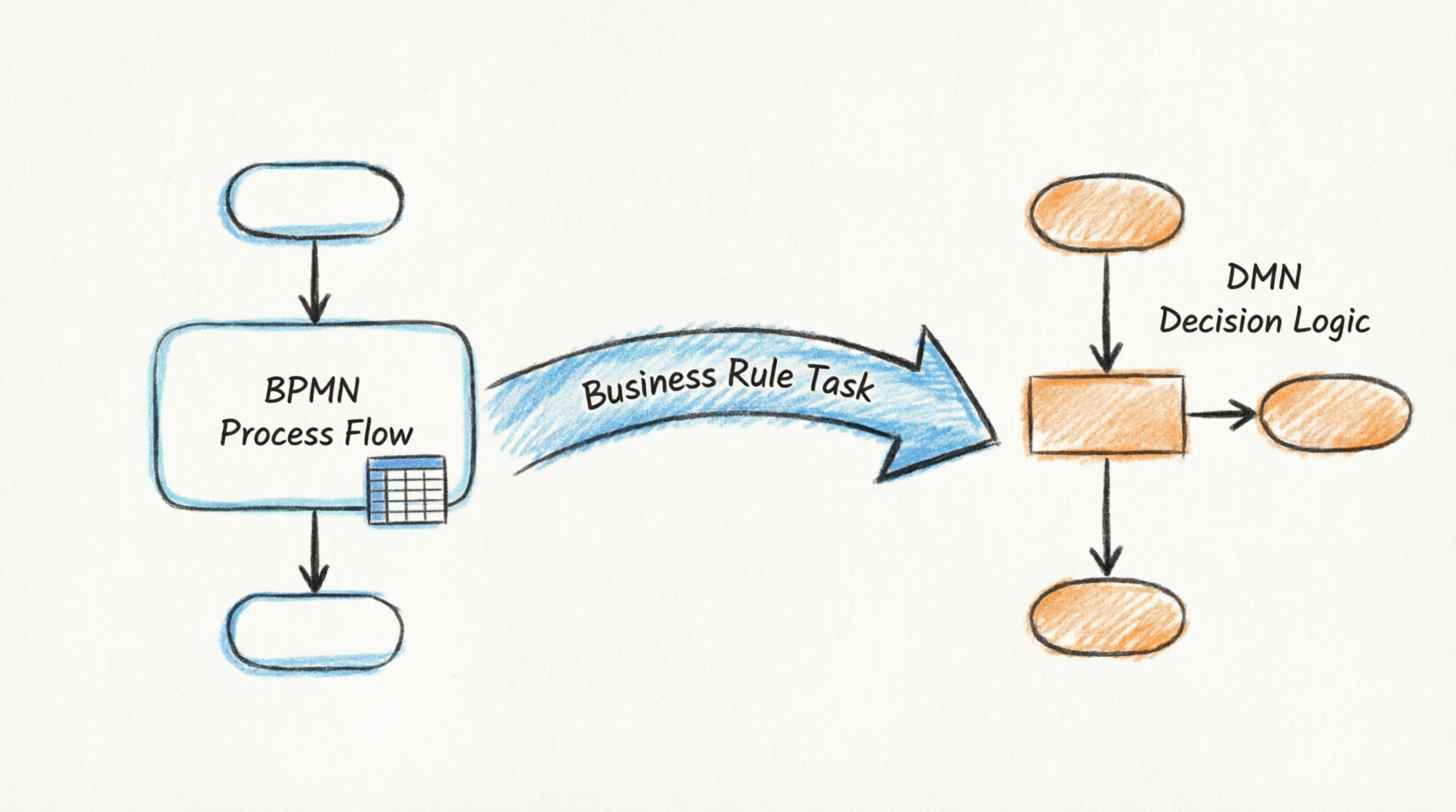
This is where Decision Model and Notation (DMN) transforms process modeling. Developed by the Object Management Group (OMG), DMN is a standard language designed specifically to describe business decision logic independently of process flow. By integrating DMN with BPMN, organizations can achieve a clean separation of concerns: the BPMN model handles the orchestration (the "how"), while the DMN model manages the intelligence (the "why" and "what"). This guide provides a comprehensive overview of this integration, offering practical examples, implementation guidelines, and expert tips for mastering decision-centric process design.
Key Concepts
Before diving into implementation, it is essential to understand the core vocabulary and architectural principles of DMN-BPMN integration.
1. Separation of Concerns
The fundamental philosophy is modularity. Process flow should dictate the sequence of activities, while decision models should encapsulate the business rules. Changing a tax rate or an approval threshold should never require redesigning a process workflow.
2. The Business Rule Task
This is the primary bridge between the two standards. In BPMN, it is a specialized task type identified by a spreadsheet icon in the upper-left corner. It acts as a service call to a decision engine rather than a manual human activity or a generic script.
3. Decision Requirements Diagram (DRD)
When you "drill down" into a DMN model, you are viewing a DRD. This visualizes the dependencies between decisions, data, and knowledge sources using specific notations:
- Decisions: Rectangles representing where logic is applied.
- Input Data: Ovals representing variables required for evaluation.
- Knowledge Sources: Shapes indicating authorities (e.g., policy documents, regulations) governing the logic.
- Requirements: Arrows showing information flow and dependencies.
4. Dynamic Linkage
Advanced modeling tools support a live connection between the BPMN task and the DMN asset. This is often visualized via a lock icon or hyperlink on the Business Rule Task, allowing stakeholders to navigate seamlessly from the high-level process to the granular decision table or literal expression.
What, How, and When
What Is Integrated?
The integration connects the process context (available data at a specific point in time) with the decision logic (rules defined externally). Specifically:
- Inputs: Process variables are mapped to DMN input data definitions.
- Execution: A business rules engine evaluates the DMN artifact.
- Outputs: The decision result is returned to the process as a variable, which can then drive gateways, update records, or trigger subsequent tasks.
How Does Integration Work Mechanically?
- Invocation: The process token reaches a Business Rule Task.
- Data Binding: The engine extracts relevant process variables and passes them as inputs to the DMN model.
- Evaluation: The DMN engine traverses the decision requirements graph, executing decision tables, literal expressions, or context functions.
- Response: The output is bound back to a process variable.
- Continuation: The process proceeds, often using the output to determine which outgoing sequence flow to take.
When Should You Use DMN Over Native BPMN Gateways?
| Scenario |
Recommended Approach |
Reason |
| Simple binary routing (e.g., "Is document signed?") |
BPMN Exclusive Gateway |
Low overhead; logic is trivial. |
| Multi-variable calculation (e.g., Credit scoring) |
DMN |
Complex arithmetic and weighted factors clutter BPMN. |
| Regulatory/Compliance logic |
DMN |
Rules change frequently; requires audit trail separate from flow. |
| Reusable logic across multiple processes |
DMN |
Single source of truth prevents duplication. |
| AI/ML Model invocation |
DMN |
Encapsulates model scoring as a decision service. |
Real-World Examples
Example 1: Capability Investment Optimization
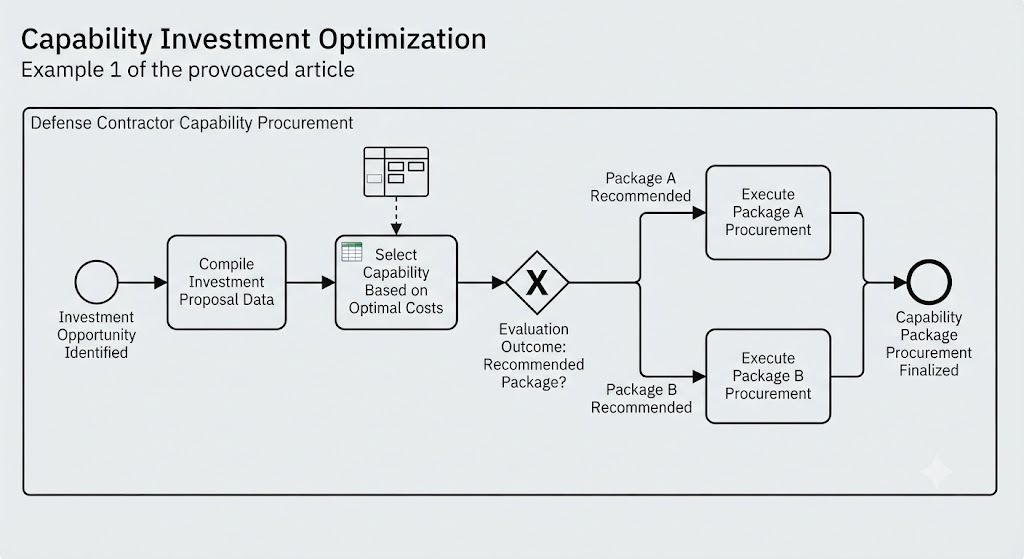
- Context: A defense contractor needs to select new capabilities based on optimal cost-benefit analysis.
- BPMN Element: Business Rule Task named "Select Capability Based on Optimal Costs."
- DMN Logic: Aggregates drone procurement costs, employee training expenses, AI technology licensing fees, and projected ROI.
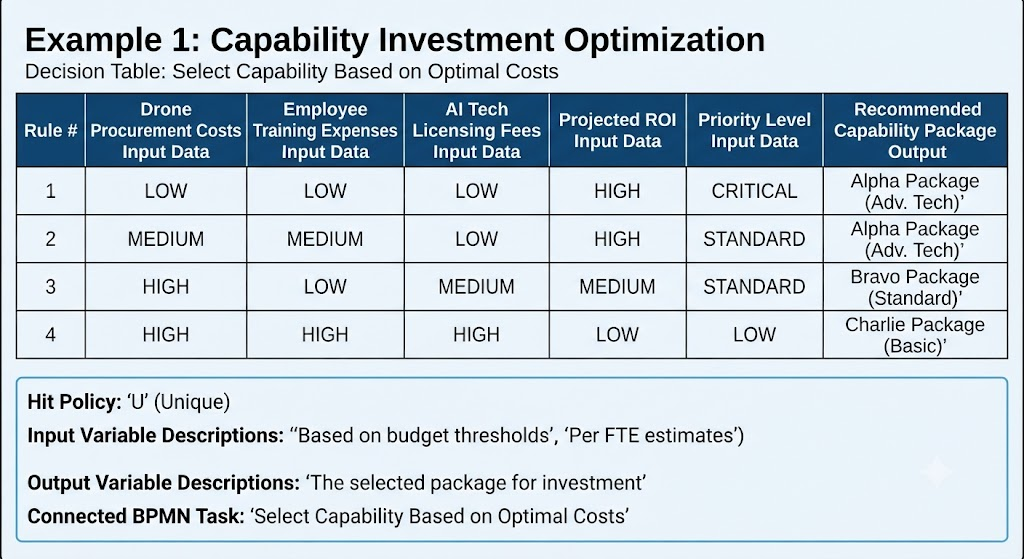
- Outcome: Returns a single recommended capability package. The process then routes to a "Procure Package A" or "Procure Package B" task based solely on this output, keeping the investment approval workflow clean.
Example 2: Autonomous Vehicle Road Evaluation
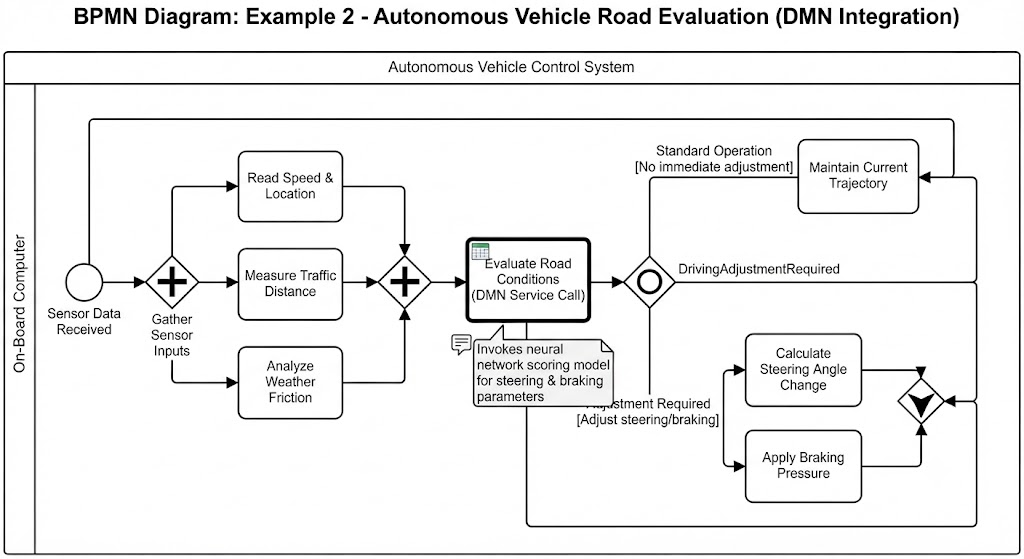
- Context: A self-driving car system must continuously adjust driving parameters.
- BPMN Element: Business Rule Task named "Evaluate Road Conditions" within a sensor-processing loop.
- DMN Logic: Takes sensor inputs (speed, traffic distance, weather friction coefficient) and invokes a neural network scoring model wrapped in a DMN literal expression.
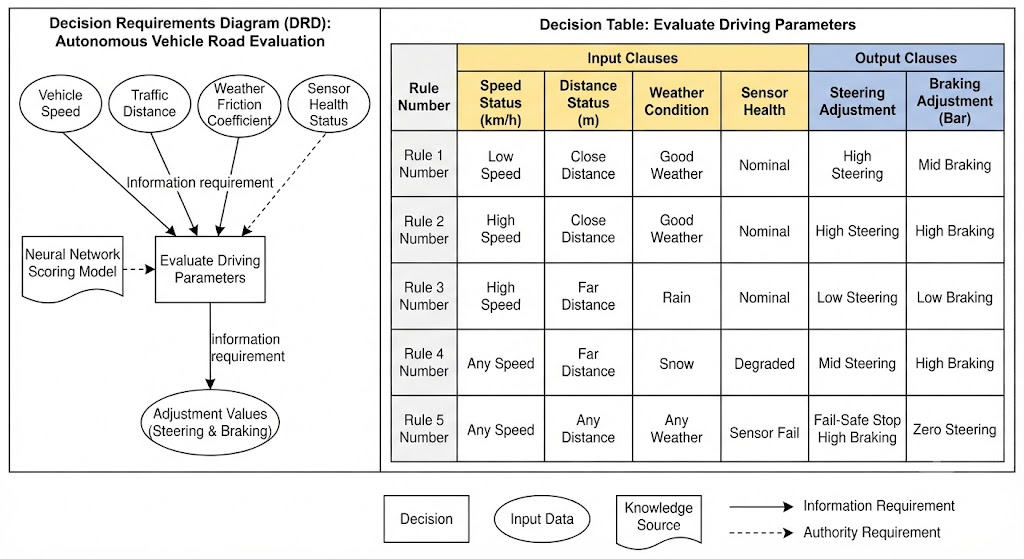
- Outcome: Outputs precise adjustment values for steering angle and braking pressure. The decision logic is versioned and auditable independently of the vehicle’s control flow software.
Example 3: Insurance Claim Adjudication
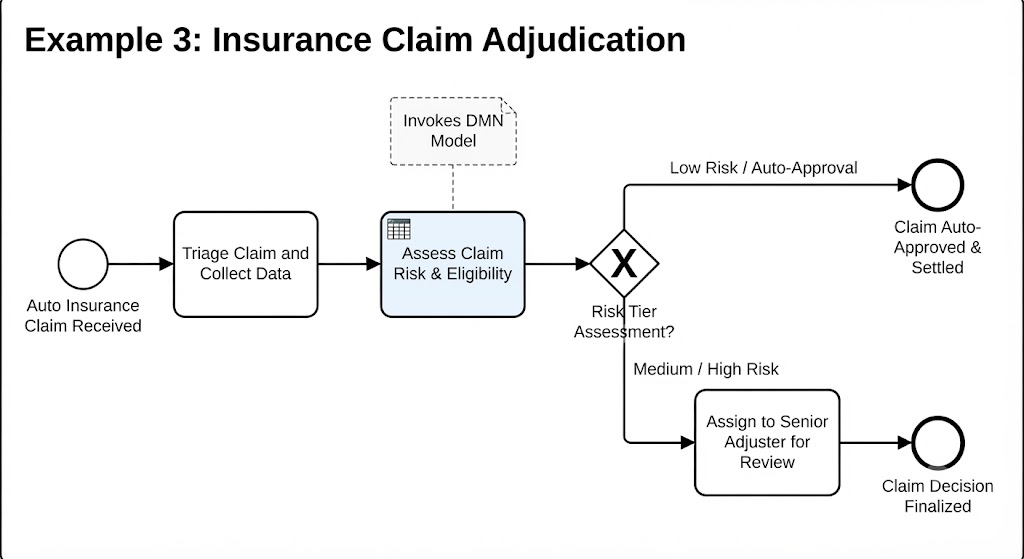
- Context: An auto insurance claim enters the triage phase.
- BPMN Element: Business Rule Task named "Assess Claim Risk & Eligibility."
- DMN Logic: Evaluates policy coverage limits, driver history points, damage estimate thresholds, and fraud indicators against current underwriting guidelines (Knowledge Source).
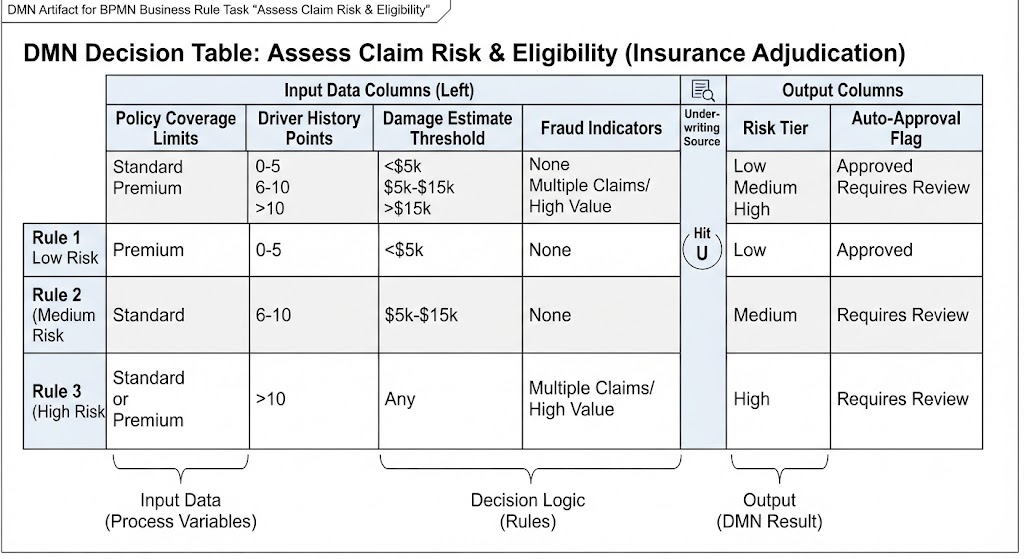
- Outcome: Returns a risk tier (Low/Medium/High) and an auto-approval flag. Low-risk claims bypass human review entirely; high-risk claims route to a senior adjuster.
Guidelines and Best Practices
- Name Decisions as Verbs or Questions: Name your DMN decisions descriptively (e.g., "Calculate Discount Rate" or "Is Applicant Eligible?") rather than generically ("Decision 1"). This makes the BPMN Business Rule Task self-documenting.
- Keep Input/Output Contracts Stable: Treat the interface between BPMN and DMN like an API. Avoid renaming input variables in DMN without updating the BPMN data mapping.
- Model Dependencies Explicitly: Always use Requirement arrows in your DRD. If Decision B relies on the output of Decision A, model it. Do not rely on implicit execution order.
- Version Decisions Independently: Leverage the fact that DMN assets have their own lifecycle. You should be able to deploy v2.0 of a pricing decision without redeploying the entire order-to-cash process.
- Validate Before Integration: Test DMN models with unit test cases in isolation before linking them to BPMN. Debugging logic errors inside a running process engine is significantly harder than testing a decision table directly.
Tips and Tricks
- Use the Drill-Down Feature for Stakeholder Reviews: During walkthroughs with business subject matter experts, start at the BPMN level. Only click the lock/hyperlink icon when they ask "How is this determined?" This prevents cognitive overload.
- Leverage FEEL Expressions for Simplicity: For simple conditional logic that doesn’t warrant a full decision table, use Friendly Enough Expression Language (FEEL) literal expressions within DMN. They are more readable than nested BPMN gateways but still externalized.
- Document Knowledge Sources: Always link to the actual PDF, regulation URL, or wiki page in the Knowledge Source element. This turns your DMN model into living compliance documentation.
- Avoid Circular Dependencies: While DMN supports some recursion, circular dependencies between decisions can cause performance issues and infinite loops. Restructure your DRD if you encounter this.
- Monitor Decision Performance: Instrument your business rules engine to log execution times per decision. Complex DMN models can become bottlenecks; identifying slow decisions early allows for optimization (e.g., caching, simplifying tables).
Conclusion
Integrating Decision Model and Notation with BPMN is not merely a technical exercise; it is a strategic approach to business agility. By externalizing decision logic into dedicated, standardized models, organizations unlock the ability to update business rules rapidly, maintain compliant audit trails, and keep process diagrams comprehensible for all stakeholders. Whether optimizing multi-million dollar capability investments, controlling autonomous systems, or streamlining insurance adjudication, the DMN-BPMN partnership ensures that your process models reflect the true complexity of your business without sacrificing clarity. Embrace the separation of flow and logic, and your process architecture will be both resilient and readable.