
In today’s fast-paced business environment, an organization’s most valuable asset is often its collective knowledge. However, much of this knowledge remains trapped in the minds of employees—informal, unstructured, and vulnerable to loss when staff turnover occurs. This "tacit knowledge" includes intuitive understandings of workflows, unwritten rules, and experiential insights that drive daily operations but are rarely documented.
Transforming tacit knowledge into "explicit knowledge"—clearly documented, shareable, and actionable information—is critical for scalability, consistency, and competitive advantage. Business Process Model and Notation (BPMN) provides a powerful framework for this transformation. By visually mapping processes through As-Is (current state) and To-Be (future state) models, organizations can uncover hidden inefficiencies, standardize best practices, and design optimized workflows.
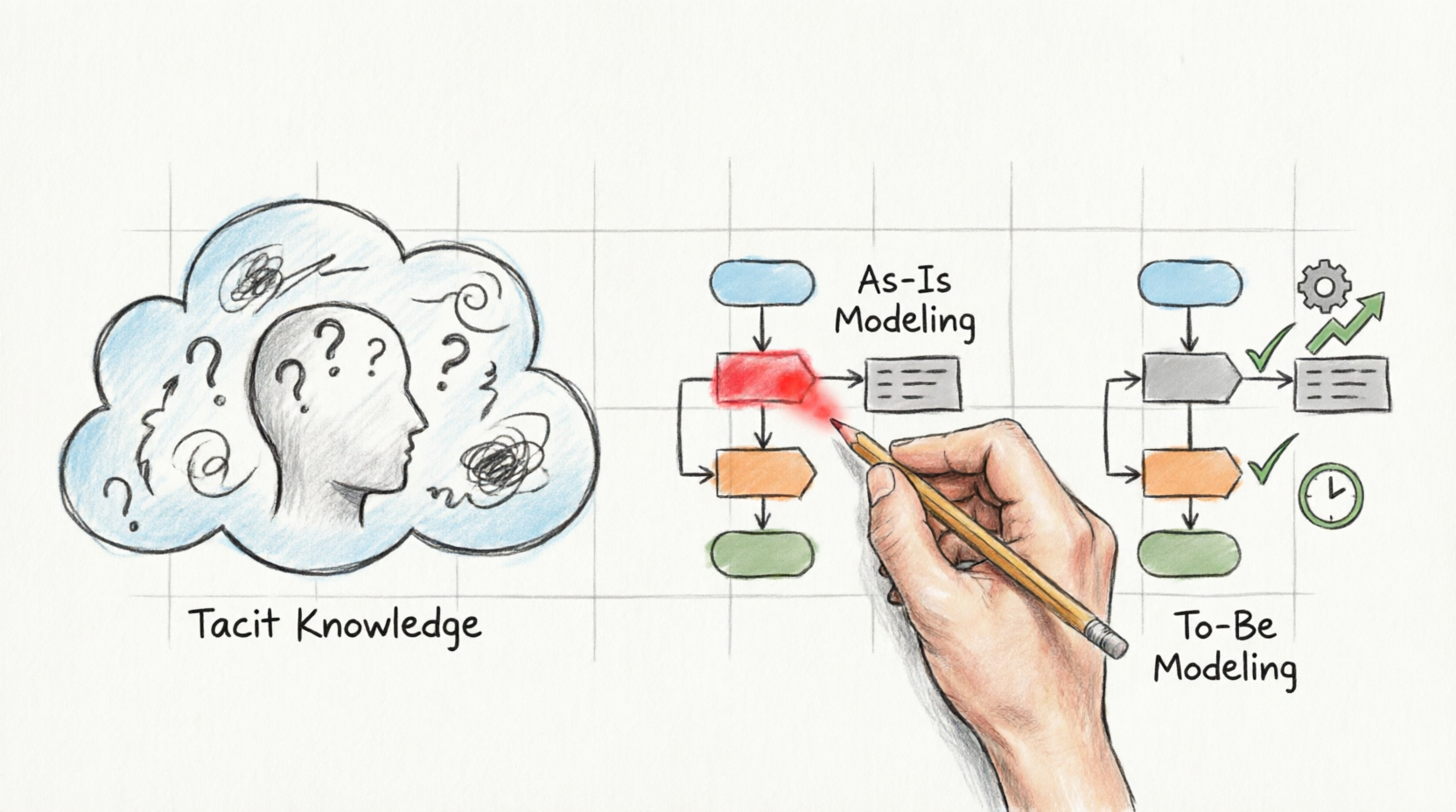
This guide explores how to leverage BPMN modeling to capture organizational knowledge, using real-world examples like Amazon’s GIG delivery model and a dry-cleaning service optimization case. You’ll learn the what, why, how, and when of As-Is and To-Be modeling, along with best practices, tips, and guidelines to ensure your efforts yield tangible business value.
As-Is modeling documents the current state of a business process exactly as it exists today, including all steps, decision points, handoffs, delays, and workarounds. It captures the reality of how work gets done, not how it should be done. This baseline is essential for identifying bottlenecks, redundancies, and areas of risk.
To-Be modeling designs the desired future state of a process after improvements have been identified. It reflects optimized workflows, eliminated inefficiencies, automated tasks, and enhanced customer or employee experiences. The To-Be model serves as a blueprint for implementation and change management.
BPMN is the global standard for business process modeling because it:
Provides a common visual language understandable by both business stakeholders and technical teams.
Supports detailed representation of complex workflows, including events, gateways, tasks, and flows.
Enables seamless transition from analysis to execution, as many BPMN tools can generate executable code or integrate with workflow engines.
Preserve Institutional Knowledge
Documenting processes ensures critical knowledge isn’t lost when employees leave.
Identify Inefficiencies
Visualizing the As-Is process reveals bottlenecks, redundant steps, and manual workarounds.
Enable Data-Driven Decisions
Models provide a factual basis for prioritizing improvements and measuring ROI.
Improve Communication
BPMN diagrams bridge gaps between departments, reducing misunderstandings and aligning stakeholders.
Support Automation
Clear To-Be models make it easier to identify tasks suitable for automation (e.g., RPA, AI).
Enhance Compliance & Risk Management
Documented processes help meet regulatory requirements and audit trails.
Accelerate Onboarding
New hires can quickly understand workflows through visual guides rather than lengthy manuals.
Drive Continuous Improvement
As-Is/To-Be modeling creates a foundation for ongoing process optimization (Kaizen, Lean, Six Sigma).
Use this approach when:
Onboarding new teams or systems: Establish a baseline before changes.
Experiencing operational pain points: Complaints about delays, errors, or customer dissatisfaction.
Preparing for digital transformation: Before implementing new software or automation.
Mergers & Acquisitions: Harmonizing processes across organizations.
Compliance audits: Documenting processes for regulatory review.
Scaling operations: Ensuring consistency as the organization grows.
Define Scope
Identify the process to model (e.g., order fulfillment, customer onboarding). Set clear boundaries.
Assemble Stakeholders
Include process owners, frontline employees, managers, and IT representatives.
Choose Tools
Select a BPMN-compatible tool (e.g., Camunda, Signavio, Lucidchart, Bizagi).
Conduct Interviews & Workshops
Engage employees who perform the process daily. Ask open-ended questions: “What do you do first? What happens next? Where do you get stuck?”
Observe the Process
Shadow employees to see real-world variations and workarounds.
Document Steps
Map each task, decision point, handoff, and system interaction using BPMN symbols.
Validate with Stakeholders
Review the draft As-Is model with participants to ensure accuracy.
Identify Pain Points
Annotate the model with metrics (time, cost, error rates) and note bottlenecks.
Brainstorm Improvements
Use techniques like root cause analysis, benchmarking, or design thinking.
Eliminate Waste
Remove redundant steps, automate manual tasks, and streamline handoffs.
Model the To-Be State
Create a new BPMN diagram reflecting the optimized process.
Simulate & Validate
Use simulation tools to test performance (e.g., cycle time, resource utilization).
Gain Approval
Present the To-Be model to leadership and stakeholders for sign-off.
Develop an Implementation Plan
Define timelines, responsibilities, and training needs.
Execute Changes
Roll out new processes, systems, or policies.
Monitor Performance
Track KPIs against the As-Is baseline to measure improvement.
Iterate
Refine the To-Be model based on real-world feedback.
Challenge: Amazon needed to orchestrate complex interactions between warehouse workers, drivers, and customers in its gig-based delivery network.
As-Is Analysis:
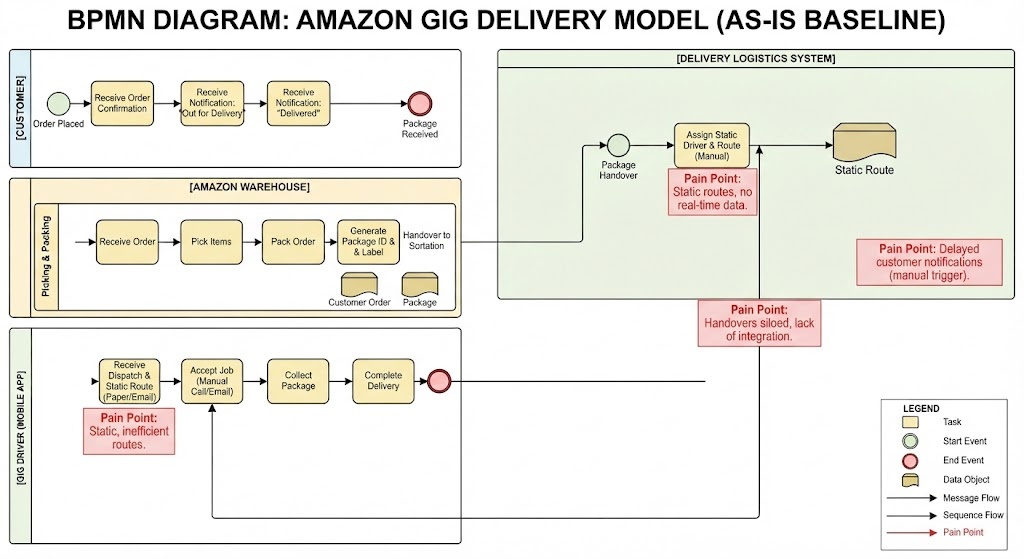
Warehouse picking and packing were siloed from driver dispatch.
Drivers received static routes without real-time traffic or package priority data.
Customer notifications were delayed, leading to missed deliveries.
To-Be Solution:
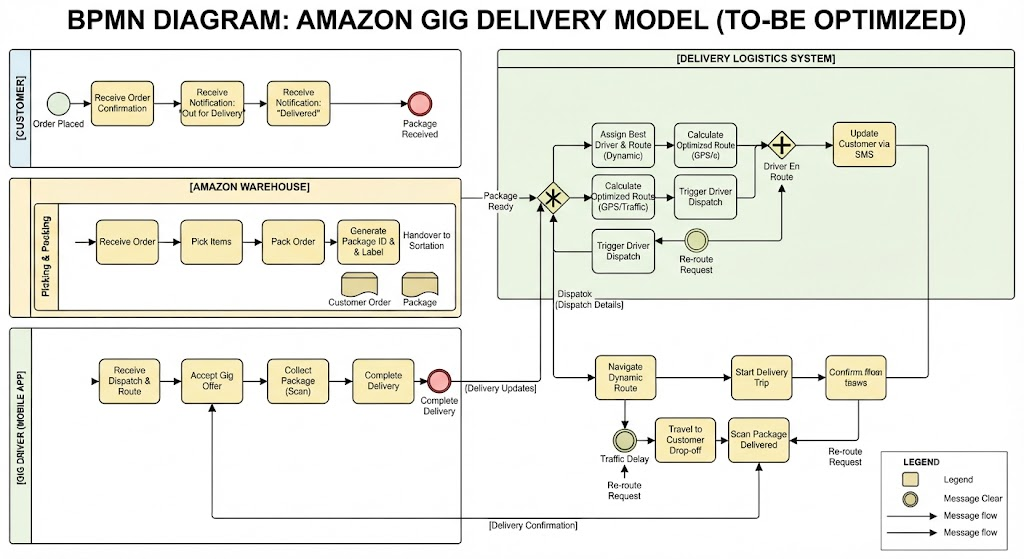
Integrated BPMN model connecting warehouse tasks → driver assignment → dynamic routing → customer notifications.
Automated triggers updated drivers’ apps when packages were ready.
Real-time GPS data optimized routes, reducing delivery time by 15%.
Automated SMS/email notifications improved customer satisfaction scores by 20%.
Outcome: Enhanced coordination reduced idle time, improved delivery accuracy, and scaled operations efficiently.
Challenge: A local dry-cleaning service faced complaints about late pickups, lost items, and poor communication.
As-Is Analysis:
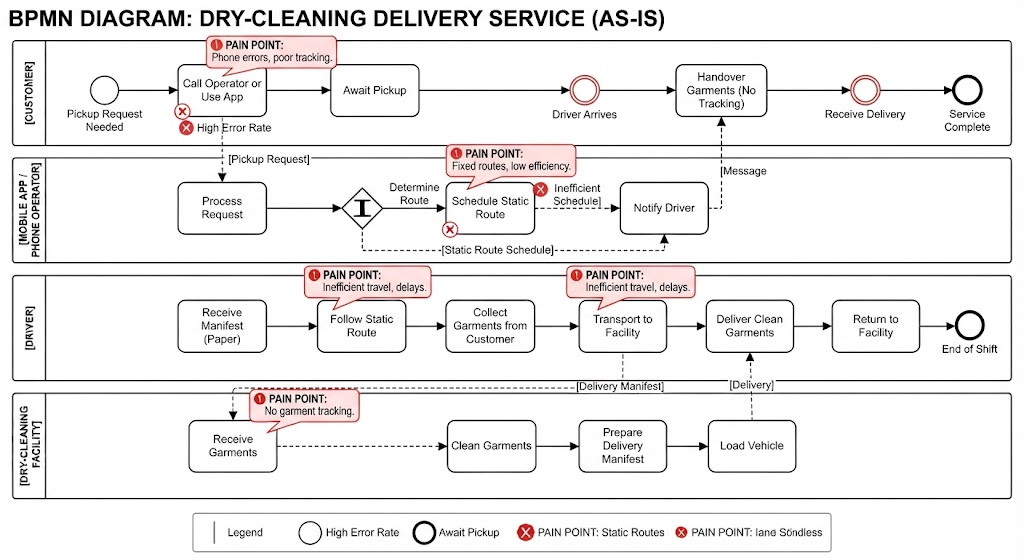
Drivers followed fixed routes regardless of pickup density.
Customer requests were managed via phone calls, leading to errors.
No tracking system existed for garments in transit.
To-Be Solution:
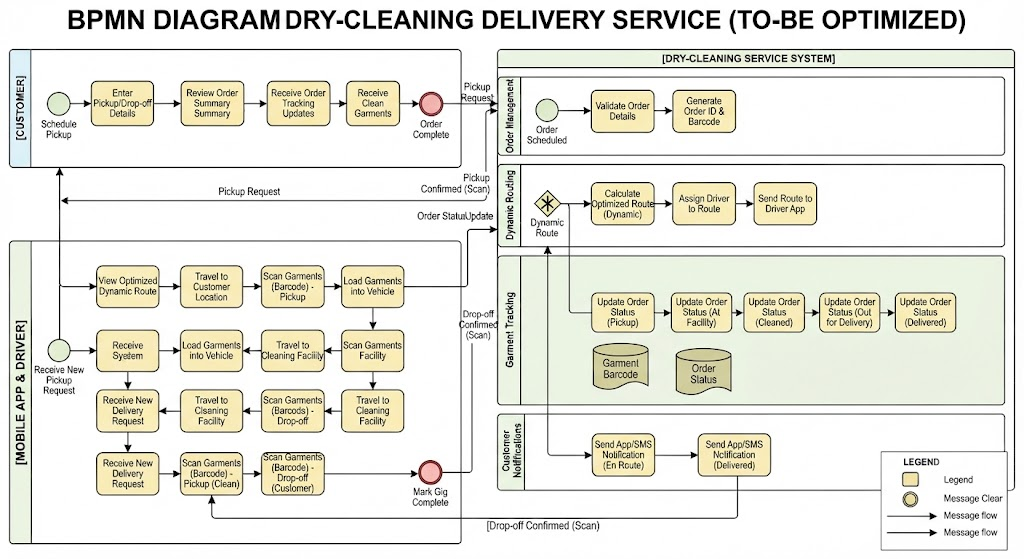
Modeled a dynamic routing system based on real-time pickup requests.
Introduced a mobile app for customers to schedule pickups and track orders.
Added barcode scanning at each handoff point (customer → driver → cleaner → driver → customer).
Outcome: Route efficiency improved by 30%, customer complaints dropped by 50%, and garment loss was eliminated.
Start Small
Pilot with one high-impact process before scaling.
Engage Frontline Employees
They know the real process, not just the official one.
Use Color Coding
Highlight pain points (red), automation opportunities (blue), and quick wins (green).
Keep It Simple
Avoid over-complicating diagrams. Focus on clarity over completeness.
Leverage Templates
Use standardized BPMN templates for consistency across teams.
Iterate Frequently
Treat models as living documents, not one-time artifacts.
Combine Qualitative & Quantitative Data
Pair process maps with metrics (time, cost, error rates) for deeper insights.
Train Stakeholders
Ensure everyone understands BPMN basics to facilitate collaboration.
| Guideline | Description |
|---|---|
| Involve Cross-Functional Teams | Include representatives from all departments involved in the process. |
| Validate with Data | Use actual performance data to confirm As-Is bottlenecks. |
| Focus on Customer Value | Prioritize improvements that enhance customer experience. |
| Document Assumptions | Note any assumptions made during modeling for future reference. |
| Align with Strategy | Ensure To-Be processes support broader organizational goals. |
| Plan for Change Management | Address resistance by communicating benefits and providing training. |
| Use Version Control | Track changes to models over time for auditability. |
| Test Before Full Rollout | Pilot the To-Be process with a small group before company-wide implementation. |
Transforming tacit knowledge into explicit knowledge through As-Is and To-Be BPMN modeling is not just a documentation exercise—it’s a strategic imperative. By visualizing current realities and designing optimized futures, organizations unlock efficiency, preserve critical insights, and build a foundation for continuous improvement.
Whether you’re streamlining Amazon-scale logistics or optimizing a local dry-cleaning service, the principles remain the same: listen to those who do the work, map the truth, design the ideal, and iterate toward excellence. With BPMN as your toolkit, you can turn informal know-how into a competitive advantage that scales with your business.
Start small, engage your teams, and let the models guide your journey from chaos to clarity. The result? Processes that are not only efficient but also resilient, transparent, and ready for the future.

