
In the modern software development lifecycle, one of the most persistent challenges is the "translation gap" between business stakeholders and engineering teams. Stakeholders articulate high-level visions, strategic goals, and process flows, often using abstract or non-technical language. Engineers, on the other hand, need precise, unambiguous specifications to write efficient, maintainable code. Too often, this disconnect leads to misaligned expectations, scope creep, and the dreaded task of reverse-engineering legacy systems to understand how they actually work versus how they were supposed to work.
Enter Business Process Model and Notation (BPMN). While often viewed as a tool for business analysts, BPMN serves a critical, underappreciated role for engineering leadership. For an Engineering Lead, BPMN is not just a diagramming standard; it is the technical bridge that transforms ambiguous stakeholder vision into actionable engineering architecture. This guide explores how Engineering Leads can leverage BPMN to provide their development teams with clear, standardized visual architectures, eliminating guesswork and accelerating the path from concept to code.
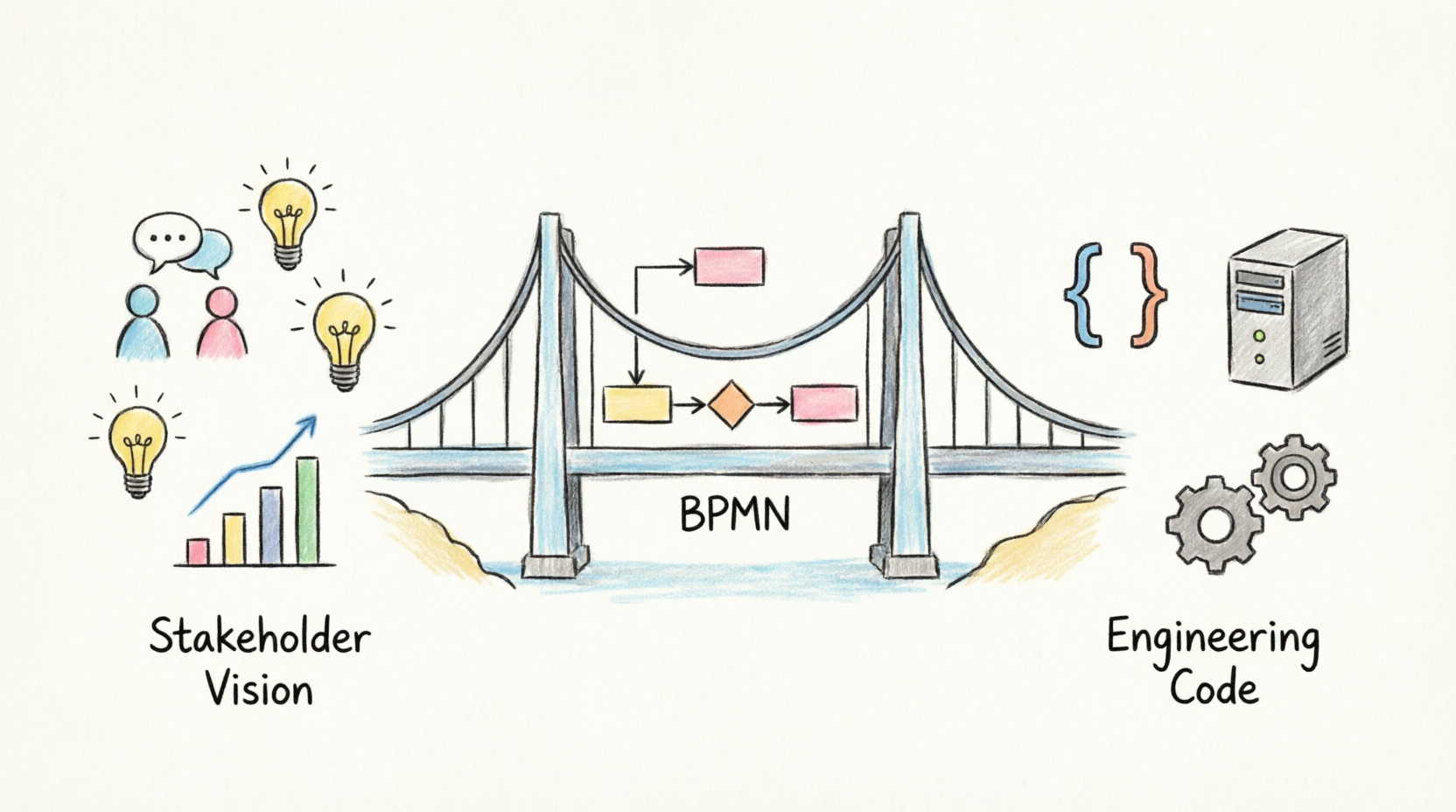
Meet Erin, an Engineering Lead at a mid-sized tech company. Erin’s team is tasked with building a new logistics tracking module. The product owner presents a series of user stories and high-level flowcharts. The sales team has promised specific SLAs. The compliance officer has outlined strict security requirements.
Erin’s challenge is not just to manage her developers’ time, but to ensure that what is built aligns perfectly with these diverse inputs. Without a clear, shared understanding of the process flow, her team risks:
Building features that don’t meet compliance standards.
Misinterpreting error handling paths.
Wasting time deciphering undocumented legacy integrations.
Erin uses BPMN to act as the "bridge between two worlds." She translates the high-level business diagrams provided by stakeholders into detailed, technically grounded BPMN models that serve as the single source of truth for her development team.
Legacy codebases are often poorly documented, with business logic buried deep within complex functions. When new features need to integrate with old systems, engineers typically spend weeks reverse-engineering the existing code to understand its behavior. This is inefficient, error-prone, and demoralizing.
BPMN provides a standardized visual architecture that documents what the system should do, independent of how it is currently implemented. By modeling processes in BPMN:
Clarity is Achieved: Every step, decision point, and exception is explicitly defined.
Ambiguity is Removed: Stakeholders and engineers agree on the process before coding begins.
Legacy Systems are Mapped: Existing systems can be modeled as-is, providing a clear reference for integration points without needing to read thousands of lines of code.
BPMN’s power lies in its specificity. It doesn’t just show "a process happens"; it defines who does it, what system is involved, and what happens if it fails. Let’s look at two concrete examples relevant to engineering teams.
Security compliance is non-negotiable. Consider a CI/CD pipeline where code must pass security scans before deployment. A vague requirement might say, "Ensure secure deployment." But what does that mean for the engineer?
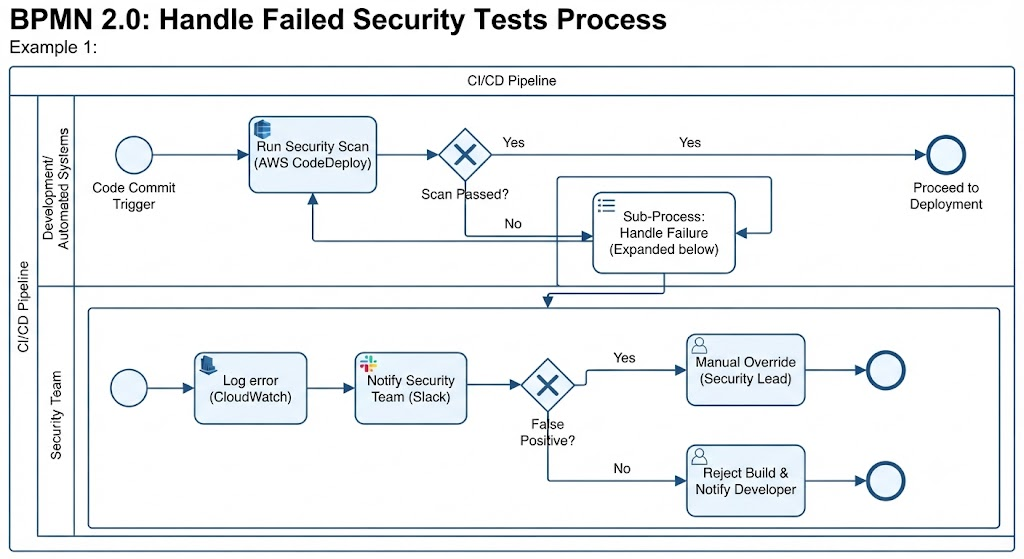
Using BPMN, Erin models the "Handle Failed Security Tests" process:
Start Event: Code commit triggers the pipeline.
Service Task: "Run Security Scan" is executed by AWS CodeDeploy.
Exclusive Gateway: Did the scan pass?
Yes: Proceed to deployment.
No: Trigger the "Handle Failure" sub-process.
Sub-Process: Handle Failure:
Service Task: Log error details to CloudWatch.
User Task: Notify the Security Team via Slack.
Exclusive Gateway: Is it a false positive?
Yes: Manual override by Security Lead.
No: Reject build and notify developer.
Engineering Impact:
System Identification: The BPMN model explicitly names AWS CodeDeploy as the system responsible for the scan. Engineers know exactly which API to integrate with.
Error Handling: The failure path is clearly defined. Developers don’t have to guess what happens when a test fails; they build the logging, notification, and override mechanisms as specified.
Compliance Audit: The model serves as documentation for auditors, showing that security checks are mandatory and failures are handled systematically.
In a logistics application, cargo must be scanned at various checkpoints. A business stakeholder might say, "Scan the cargo when it arrives." But engineers need to know: What if the scanner is offline? What if the barcode is damaged?
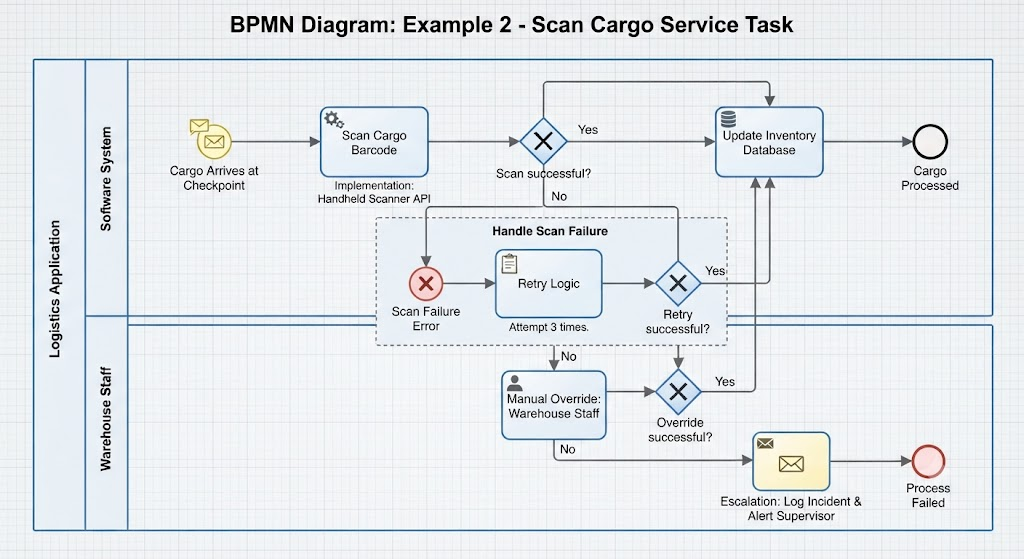
Erin models the "Scan Cargo" service task with precision:
Service Task: "Scan Cargo Barcode."
Implementation: Integration with handheld scanner API.
Exclusive Gateway: Scan successful?
Yes: Update inventory database.
No: Trigger "Handle Scan Failure" event.
Event Sub-Process: Handle Scan Failure:
Retry Logic: Attempt scan up to 3 times.
Manual Override: If retries fail, trigger a User Task for warehouse staff to enter ID manually.
Escalation: If manual entry fails, log incident and alert supervisor.
Engineering Impact:
Scaffolding for Code: The BPMN model provides the scaffolding for the system code. Developers can directly translate each BPMN element into code modules:
scanCargo() function.
if (scanSuccess) { updateInventory() } else { handleFailure() } logic.
retryScan(attempts=3) utility.
Success/Failure Criteria: The model explicitly defines what constitutes success (barcode read) and failure (barcode unread), ensuring robust error handling is built in from day one.
To maximize the value of BPMN, Engineering Leads like Erin should follow these best practices:
Collaborate with Stakeholders: Don’t create BPMN models in isolation. Walk through the diagrams with product owners and business analysts to ensure accuracy.
Use Standard Notation: Stick to BPMN 2.0 standards. Use Service Tasks for automated systems, User Tasks for human interactions, and Gateways for decisions. This ensures readability for all technical team members.
Link to Technical Specs: Annotate BPMN elements with links to API documentation, database schemas, or Jira tickets. This keeps the model connected to the actual implementation details.
Iterate and Refine: Treat BPMN models as living documents. As the system evolves, update the models to reflect changes in architecture or business logic.
Focus on Exception Paths: Most bugs occur in edge cases. Spend extra time modeling failure scenarios, timeouts, and error handling paths. This is where BPMN adds the most value for engineers.
For Engineering Leads, BPMN is far more than a business analysis artifact. It is a powerful engineering tool that brings clarity, precision, and efficiency to the software development process. By acting as the "bridge between two worlds," Engineering Leads can use BPMN to translate high-level stakeholder visions into detailed, actionable technical designs.
As demonstrated through the "Handle Failed Security Tests" and "Scan Cargo" examples, BPMN provides the scaffolding engineers need to build robust, compliant, and well-architected systems. It eliminates the need for costly reverse-engineering, reduces ambiguity, and ensures that every member of the development team is working from the same playbook.
In an era where speed and accuracy are paramount, embracing BPMN allows Engineering Leads to empower their teams to focus on what they do best: writing great code, confident in the knowledge that they are building exactly what the business needs.

